Canyon by Jim Davis

Canyon
Pop Art happened mostly in Manhattan.
A dirty hanging pillow swings from string
& holds a plum pit in its many mouths.
Nightingale sings from the lawn. Carroway
seeds in the green harbor light, the way
an eagle applies paint: with his beak
until he finishes art school, then he covers
himself in cyphers & flops around. Dig
tonality under the museum. Like the re-
contextualization of ephemera. Like the re-
configuration of magicians with pigeons
in their coat pockets. Everyone sweating
in the painting of a red candle turning blue.

About the Poet
Jim Davis is an MFA candidate at Northwestern University. His work has appeared in Wisconsin Review, Seneca Review, Adirondack Review, Midwest Quarterly, and Contemporary American Voices, among many others. Jim lives, writes, and paints in Chicago, where he reads for TriQuarterly and edits North Chicago Review.

Island by Allan Kaplan

Island
A lasso leaps from the ancient fisherman’s
long fingers collaring the pier post,
as the foredeck lifts him like a ballerina:
the swells stretching the sea
like worn trousers about to tear.

Night: The waves’ mob roar chases
the old poet’s ministers of body and soul
beyond the broken clam shells, rags
of seaweed: moon-shimmering wavelets
wash over his toes like petrified stones.

A yacht, partnered to a dancing buoy, wobbles
like a mime doing his coming-home-drunk—
dawn’s opening skit!

About the Poet
Allan Kaplan spends much daytime alone writing and revising, or watching endless late night movies with wife. Books: Paper Airplane (Harper & Row) Like One of Us (Untitled). Poems appeared in journals of various persuasions over the years; i.e.  Poetry, Apalachee Quarterly, Paris Review, Iowa Review, Quarterly Review of Literature, Washington Square Review, Barrow Street, Wind, Folio, Gulf Stream, Widener Review, Nimrod, MPQR and Bad Penny Review.

Debris by Huda Zavery

Debris
I still remember the days when you would soar across the open skies
Arms outstretched in the air
Ready to catch anything that would come in your way
But then one day, you didn’t catch a breeze, made a wrong turn
And winded up with handfuls of debris and disappointment
So you stopped trying
You folded yourself in
Crumbled yourself into a ball
Like an unfinished poem you’d scrunch up and toss over your shoulder
When you decide you don’t want to finish it
But darling, you’re being too hard on yourself
You aren’t allowing yourself space to make mistakes
Forcing yourself to walk when you have yet to learn to crawl
Take it easy
The world is a safe place to make mistakes
Mistakes are what make us up
So uncrumble yourself, unfold
Smoothen out your old creases and fold yourself into an origami bird instead
No matter how many times you mess up, the sun still rises again every morning to remind you that it is not the end of the world
Even though it may feel like it is sometimes
You can’t touch yesterday, so why in the world are you letting it touch you?
Tear out the pages of your old journals, and set them to flames
The past is in the past; it’s never coming back
All that’s left of the past is fading memories, lessons learnt, and pages going up into smoke
None of which can hurt you
Just take advantage of the past
Use it as your guidance
Don’t be afraid to outstretch your arms again
It’ll be alright, darling
You’re alright

About the Poet
Huda Zavery, is 16 years old, from Toronto, Ontario. She is a published poet and novelist, and her book “The Art of Letting Go” is available at Lulu.com.

Two Poems by Devin Murphy

Dancers
I think of you as a sock-footed girl dancing by
yourself across your hardwood bedroom
floor, imagining who you would love, your glum
father both annoyed and pleased by the
shaking of the light over his reading chair,
even then the smooth flute of your calf was
becoming a profound form of punishment
to me, your hair my hand out the window,
your voice opera, Carmen at Masada, Don
Giovani in the Warsaw salt mine cathedral,
holy sounds, sacred notes. It is a shame
that I sold myself as perhaps something close
to that ghost dancer—as you now know you
will need to shoulder me from the base of the
toilet to the bed as that is part of the deal with
me, part of the dance I know, the wobble waltz,
where I place my palm over your naval until our
child kicks and joins our out-of-sync Bolero.

This News Cycle
This new cycle came with Mawin,
the four-year-old Syrian boy wandering
the desert with only a picture of his mother
and a plastic bag of dry rice, trembling and
sucking on the hard grains, swallowing
one at a time—
then came the Mexican shark hunter blown
off course, lost at sea for eighteen months,
found drifting near a South Pacific atoll
where he told of a dead partner and a diet
of sea birds, fish, and hand-scooped turtle
meat, and how a grown man could now
rest a finger between the valley of his ribs—
U.N. Human Rights Tribunal releases
studies on violations in North Korea
with stories of imprisoned women giving
birth, and how the magic of other women
coming to help with steel bowls to bathe
the newborns was twisted by guards who
made the new mothers place their screaming
infants stomach down in the bowl and let
them drown—
In the seas off of Great Britain an abandoned
cruise ship with cannibal crazed rats is said to
be pushing its way to shore, and a frenzy builds
and the ship gets lots of play until it slips off radar—
when the Sochi Olympics start and news of
Russian officials poisoning stray dogs to thin
them out carries—
until the areal skiers untether from
the earth and spin through the fog and snow
and it is a gift to see people launched, stacked
image upon image, story upon story, until
night upon night spin past, and we can add
ourselves to the endless ways of how we disappear.

About the Poet
Devin Murphy’s recent work appears in The Chicago Tribune, Glimmer Train, The Michigan Quarterly Review, The Missouri Review, and Shenandoah as well many other literary journals and anthologies. He holds an MFA from Colorado State University, a Creative Writing PhD from the University of Nebraska—Lincoln, and is an Assistant Professor of Creative Writing at Bradley University.

Two Paintings by Allen Forrest

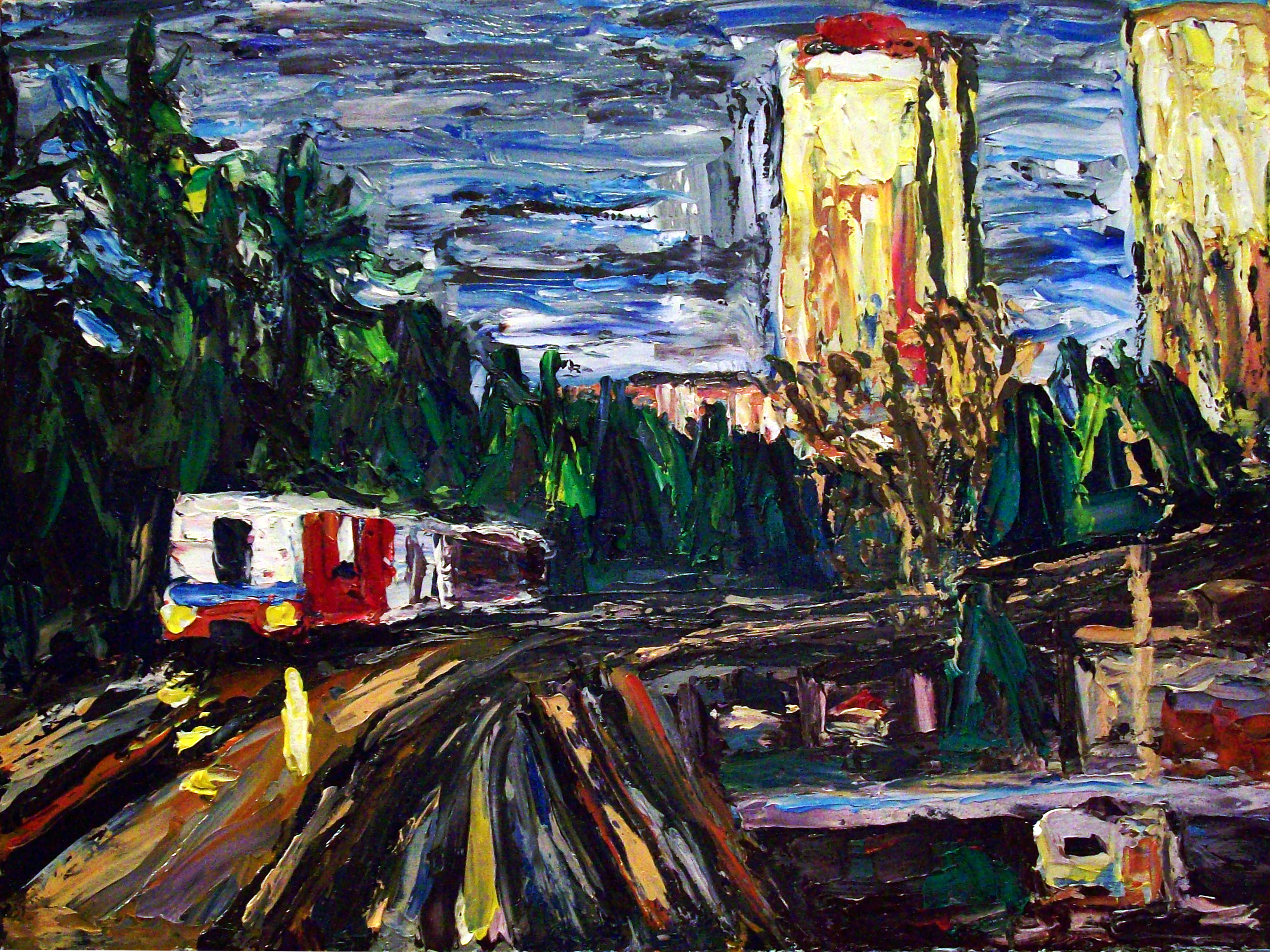
 Burnaby, B.C., Morning Sky Train (oil on canvas)
forrest_morning_skytrain_burnaby_bc_oil_on_canvas_panel_11x14_2015
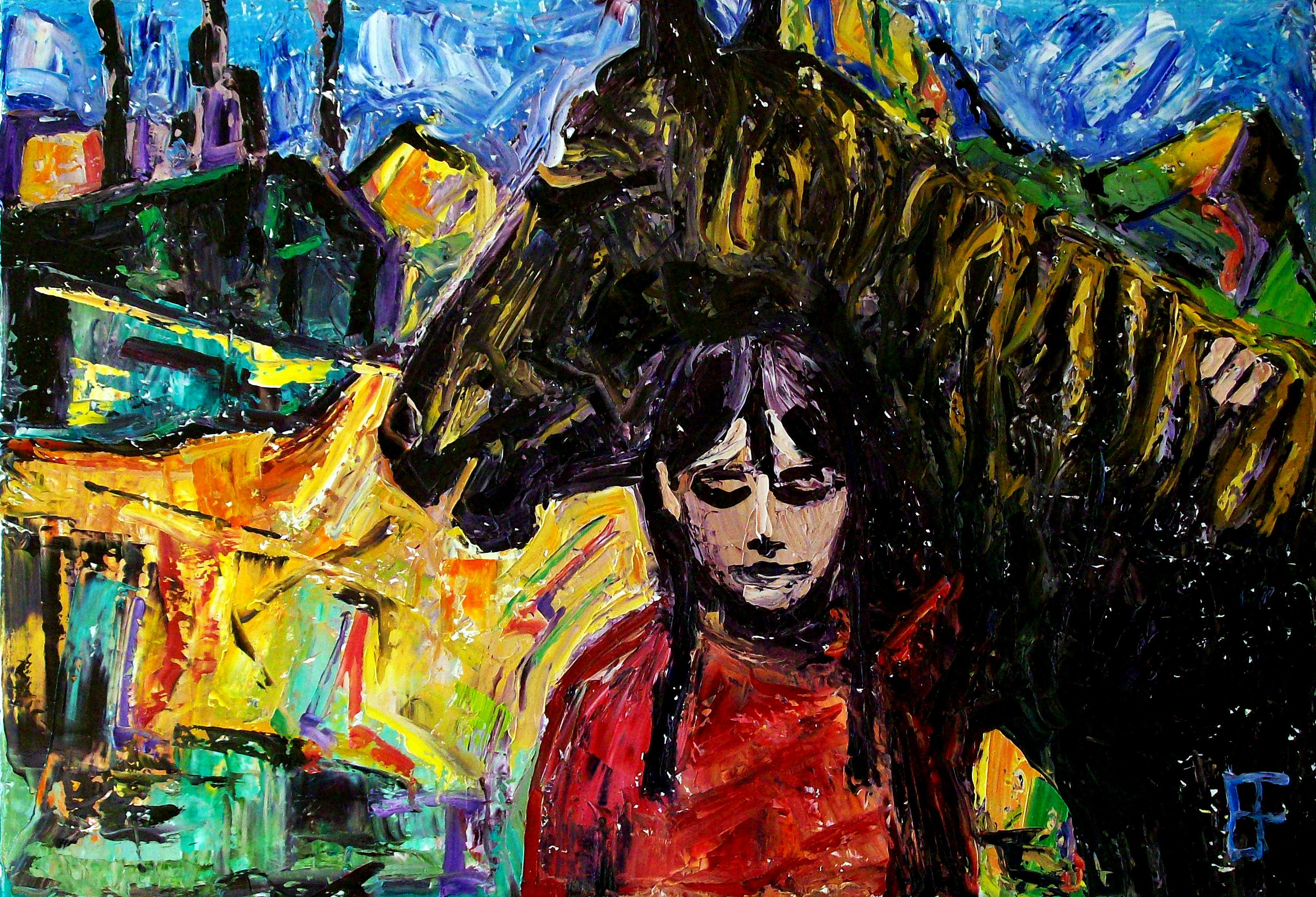
Girl and Horse (oil on canvas)
forrest_girl_and_horse_oil_on_canvas_20x30_2012
About the Artist
Allen Forrest is a graphic artist and painter born in Canada and bred in the U.S. He has created cover art and illustrations for literary publications and books. He is the winner of the Leslie Jacoby Honor for Art at San Jose State University’s Reed Magazine and his Bel Red painting series is part of the Bellevue College Foundation’s permanent art collection. Forrest’s expressive drawing and painting style is a mix of avant-garde expressionism and post-Impressionist elements reminiscent of van Gogh, creating emotion on canvas.


Issue 2 Exquisite Corpse Collaborative Poem Project

Snow Unfathomed Spring-sick Creole Thyself Carving Dawnknots
By Joe Balaz, Franklin K.R. Cline, Ray Holmes, Nina Kossman, Peter Res, James Sanders and Judith Skillman

Chiefs will win the next five Super.
Poker dogs silently mourn the death of the Great Poet.
The heavy fat blossoms like constellations
and da pidgin words wuz like foreign wings.
Do not listen to the knowing ones. Listen only to the wind.
Since kindling that angry buzz
g-g-g-g-g-g-g-g-g-g-g-g-g-g-g-g-g-g-g-g-g-g-g-g-g-g-g-g-hosts

Note: This is a different version of an exquisite corpse with no restrictions. Each poet contributed a word for the title and a line for the poem. Everything will be organized according to whoever responded first. The resulting poem can be a little chaotic, since each poet does not know what has been written or what will be written. 

Methodologies of Grace by Carol Shillibeer

Methodologies of Grace
1

There is a window that cracked. In the blistering heat of language,
there hissed by cool and faint, mountain air, far,
over the ranging hills, the walking
earth (the Cool Mind) tireless the breeze seems,
sweet with the ghost of flowers blooming leagues,
far into the body’s stoney green,
loops and loops of infinite iteration.

There is a window cracked. The watch tower roasts
above its linguistic stilts.
Before, it was other than this. It was never other than this.
And yet, the desert heat of words breaks holes in their own floors,
(there is always a way out) recursive seed, bloom, bee and seed;

roots gleam at night, they, thorns, petals,
reflective morphemes of competence,
between house and earth
cognition bees hunt their aromatic signals,
bees in the skull, and hives,
through the glass pane of linguistic separation
from the thingness of the world,
hiding the thingness of the self. This is
not. This is only this. Flowers break open with the beauty of it.

2

Asked once, if “approaching seizure, then later” was based on a real event, I had to agree that it was. It was the least false thing I could say. This poem you are reading tumbles down the same rocky slope of facticity. I will say, for example, that the crack in the glass is my particular form of epilepsy.

It is true that I was diagnosed as a petite mal epileptic. Epilepsy does run in my family, but really I have no idea if the identities that erupt during “seizures” are erupting due to the particular neuronal organization we name petite mal, or if there is another odd cognitive process going on. I don’t even know if such fissures in cognitive constructed-reality are an oddity. Sometimes I think these alternate assessments of identity and reality are always there; but normally, they are unconscious thoughts―unconsciously active ones, ones that carry sharp objects, ones that have managed to poke a hole in the monolith of their absence from awareness.

3

I don’t resent language for the presence of such absence. I’ve come to realize, with repeated attention to the form these quiet breezes take, that they are always there. In fact in sleep, when the blaze of language is at its most dormant, that which we imagine as mountain air, takes on shape, colour, tactility―in dream, in sleeping  memory―and thus (escaped through the floor boards of the linguistic watchtower) parades itself, for itself. The body thinking.

It is the watchtower, a newcomer, useful for Neighbourhood Watch, but with some peculiar ideas. Reminds me strongly of the lantern fish, as if the symbiosis of luminescent bacteria and a pendant fishy corpuscle—(dangling with an evolutionary attitude from a modified dorsal spine) in which they house themselves—as if they were all that.

So it’s useful for hunting in the dark of the sea—the lantern is not the fish; language is not the human. Dude, I want to say. Dude. Get a grip.

4

The glass, with language, ceases upon sleep.
The poem, ceaseless in its breath,
with no known impediment
(except for death),
an elbow pressed
.         between feather and bone
.                                takes on stanzaic proportions.
The limit of the legs’ ability
to reach beyond the warm pocket,
a line
.          break.

5

Having realized the ubiquity of the Cool Mind, as a child I set about attending Her. As if she were my Queen, I carry Her prize possessions. By becoming the stone carrier, I have learnt to recognize the first curling strands of wordless thought, or at least, I have reached out toward the edges of my perceptual ability and am thus able to perceive the body thinking. In other words, I keep my person, as much as is possible, tactile and aware of the cool that sparks the blaze of language.

I am quite sure that much goes on in the world
.                                                             (beyond the watchtower)
goes on
.                             the inner stones and breezes
.                            which I cannot perceive,
.                                                           which we
.                             a                                cannot
but I remain vigilant, and hopeful
that I
.          that I will manage
.                          more violence              against absence.

6

These are the methodologies of grace.

About the Poet
Carol Shillibeer lives on the west coast of Canada. Her publication list and contact information is at carolshillibeer.com.

Two Poems by Richard Fein

Relaxing the Grammatical Rules of a Dying South American Language
The language is pronounced as trio. The spelling is uncertain.
The village is in Suriname.

Truth is a grammatical necessity in Trio.
The syntax of this language makes liars speak poorly,
for one must name the direct source for each quote.
So when a stranger entered the village and read
from the talking leaves wrapped in hides,
how the Great Shaman, Jesus,
commanded the tribe to follow the god of the strangers,
that stranger’s sentence was grammatically incomplete.
For if the stranger was never eye-to-eye or ear-to-ear with that Great Shaman
how could he know what words the Shaman actually spoke?
In Trio the outcome of each verb is also part of its conjugation.
There are a half-dozen ways to qualify “to hope”
and a dozen ways to modify “to despair,”
but in their vocabulary of truths “to love” has no meaning.
for that infinitive, to love, is like a wide palm leaf that blocks the sun
and casts a penumbra that muddles clear distinctions.
In their tongue no one loves another,
rather they proclaim shades of affection.
One must speak this language meticulously,
for in this tongue hearsay is defined, lies exposed, and truths heard
in the myriad nuances of inflections.
Once upon a time truth and Trio were linguistic twins.
But enter gasoline generators, radios, and so many other fast-talking strangers.
Now when their grandparents try to teach them the old truths,
the grandchildren reply, “We’re listening,” but without a trace of inflection.

Auditions for My Multiple Personalities
I’ve typed not one character on paper
and so my room is full of my usual characters.
The writer in me issued my casting call.
Variety magazine classifieds must dangle somewhere in my brain,
for how else could this crew so suddenly show up?
The activist demanding to be heard,
the old Chinese guy who mistakes meaningless platitudes for Buddhism,
the disillusioned priest, rabbi, minister, the playboy,
the lonely lover, the baseball homerun king, the woman scorned.
The woman scorned???
Among this casting call of wannabe masculine thespians
is there an actual drama-queen queen anxiously awaiting her cue?
And of course there’s always the penniless writer in his daytime waiter garb,
that generic misunderstood oh so tortured alcoholic soul.
For isn’t every writer a closet-alcoholic puking out Shakespearian drivel?
I tell them all, once again, I can’t pay. All they’ll get is exposure,
exposure for a cast of self-absorbed exhibitionists upstaging one another.
Suddenly the personalities dematerialize, except the one in the mirror.
He yells, “Exposure my ass.”
He rips off his clothes and curses me for wasting his time,
then demands carfare to go home.
But I’m broke, and besides he is home.
So now he’s running around naked in my living room
waving blank typing paper.
I’d tell him to leave but I’d be ordering myself around,
and I take orders from no one.

About the Poet
Richard Fein was a finalist in The 2004 New York Center for Book Arts Chapbook Competition. A Chapbook of his poems was published by Parallel Press, University of Wisconsin, Madison. He has been published in many web and print journals such as Cordite, Cortland Review, Reed, Southern Review, Roanoke Review, Green Silk Journal, Birmingham Poetry Review, Mississippi Review, Paris/atlantic, Canadian Dimension, and others.

Ours Poetica by Franklin K.R. Cline

Ours Poetica
  a                            For Cole Swenson
When I stand close enough, it
peeks into my peripheral
vision. Step back and it provides
a smaller and smaller point
of emphasis. Look into me.
What we make becomes us.
Let me make a world around
you, to show you the world
around me, the shape of if.

***

It can’t be too big. This land is quiet, simple. No murders here. Not anymore. It should honor that. Flatter. Abstract. From bronze. Curved up a bit. Nonsense. Wavy, like the hills. Put it in the middle of the field. Something symbolic of what we believe about nature. Not about what we know. Put holes in it so when someone saunters up to it they can see the sky, the field. An amorphous shape. Humanity doesn’t really befit this land anymore. Holes and waves. Something to frame the view. Circular. Smooth, forgiving curves. Stolen land. Nothing jagged or cruel looking. Maternal. The suggestion of rolling.

***

Give me an atom the size of my head! You
become nature, lucky! If I name it,
they will come. If they come, we can
finally eat all the food that’s getting
cold. I don’t know about
me, but it
sure looks like I want you by the way
my hand involuntarily stretches your
way. I’m so bland compared to
yellow flowers, I’m hardly
geometry. The conveyor belt Earth
ain’t doing me any favors. I graffited
the stop signs in my neighborhood to
read DON’T STOP BELIEVIN’ and now
every intersection is an art museum. My
first inclination is to use
words. The trees all look the same. What
goes into our head is what we see. Easy
peasy, no? The tree grows right into me, and you,
as we look past each other. I love your head, how it can so easily become.

About the Poet
Franklin K.R. Cline’s poems have been featured in Banango Street, Matter, Oyez Review and Word Riot. He is an enrolled member of the Cherokee Nation and a PhD candidate in Creative Writing at the University of Milwaukee-Wisconsin. He lives in Milwaukee with three cats and his wife, Rachel Kincaid.

Two Poems by Kelli Allen

If Fairy Tales in Fall
It isn’t so much that the leaves are dizzy as it is they are lodged in confusion,
the same variety that persuades us to jump when the waters are on the rise. We
say, “look” as our feet reappear after tumbling over our shoulders on the way
down, we tremble and spill over. The repair work is universal
as the rake scratches our sides.

I contain so much thinning, yet lushness is my fresco when I stop at the bottom
of the well, climb back into the bucket and yell up “It matters! It matters!” until
only the rope tail hangs near the stone rim. Nothing whorls up in a shock
the way a name does, when its ours, all peacock and hiss, all vowel and cinnamon.

You have been told how to cut back the trestle, to light the lamp and fold your hands.
This way, we are advocates together for a splayed phrase and retelling. The only
stories we can give back are ones considerate of the moss digesting the ledge.

Suspending Delirious Limbs
Although I do not claw at my own chest, I recognize the desire as just that—
desire. It is a recitation of horrors, spoken in close iambic pentameter, which keeps
my hands, rounded fingers points against palms, close to my sides.  I say the cross
-hatched words in monotonous rounds, vowels slow, consonants exhausted,
becoming flat, and so calming.  Her wrists are the knotted tree where the rabbit sits,
eggs in its belly, waiting for Ivan.

Where my mother’s hands would have caught against pearlescent buttons when she
ripped through one blouse or another, trying to free breath, skin, small
cranberry-red streaks of rising flesh, mine stay this still. There are no legs long
enough to reach the branch where I was hatched.

So she has given me a house I am not to touch, its windows smaller than my
earlobes, its faces through the doors colder than expected. We stand on either side
of a roof peppered with mica, the pinks making me ache, the hues making her clutch
her peter-pan collar as I lean too close, too far inward.

There is no act of rebellion in remembering and I am trying not to hate this self
as compared to her self, compared to both selves one on either side of a dollhouse
made whole by attention, careful, careful attention.

About the Poet
Kelli Allen’s work has appeared in numerous journals and anthologies in the US and internationally. She is currently a Professor of Humanities and Creative Writing at Lindenwood University. Allen gives readings and teaches workshops throughout the US. Her full-length poetry collection, Otherwise, Soft White Ash, from John Gosslee Books (2012) was nominated for the Pulitzer Prize. See www.kelli-allen.com.